G-CIM · Partner Feasibility Brief
Prepared for HP Inc. — Imaging & Printing
Feasibility request · Confidential

A 4mm pouch cartridge and a fixed-head printer that live inside an 18mm laptop base

G-CIM builds a learning laptop for students. We want on-demand printing on the device itself, and we are asking HP whether this architecture can be built.

When we last spoke, the answer was that a printer this thin was not realistic. That answer made sense against the parts being discussed at the time: a standard rigid TIJ cartridge and a carriage that has to sweep the width of the page. Both of those are what make the package too deep.

So we designed around them rather than against them. The cartridge is now a flexible pouch, 4.0mm thick, that drops into a flush dock in the base deck. The printhead is a fixed strip with paper moving past it, the way a receipt printer works. There is no carriage and no rail. Everything sits inside an 18mm base.

We are not asking HP to shrink an existing cartridge. We are asking whether HP can build this specific part, and what it would take to do it with us.
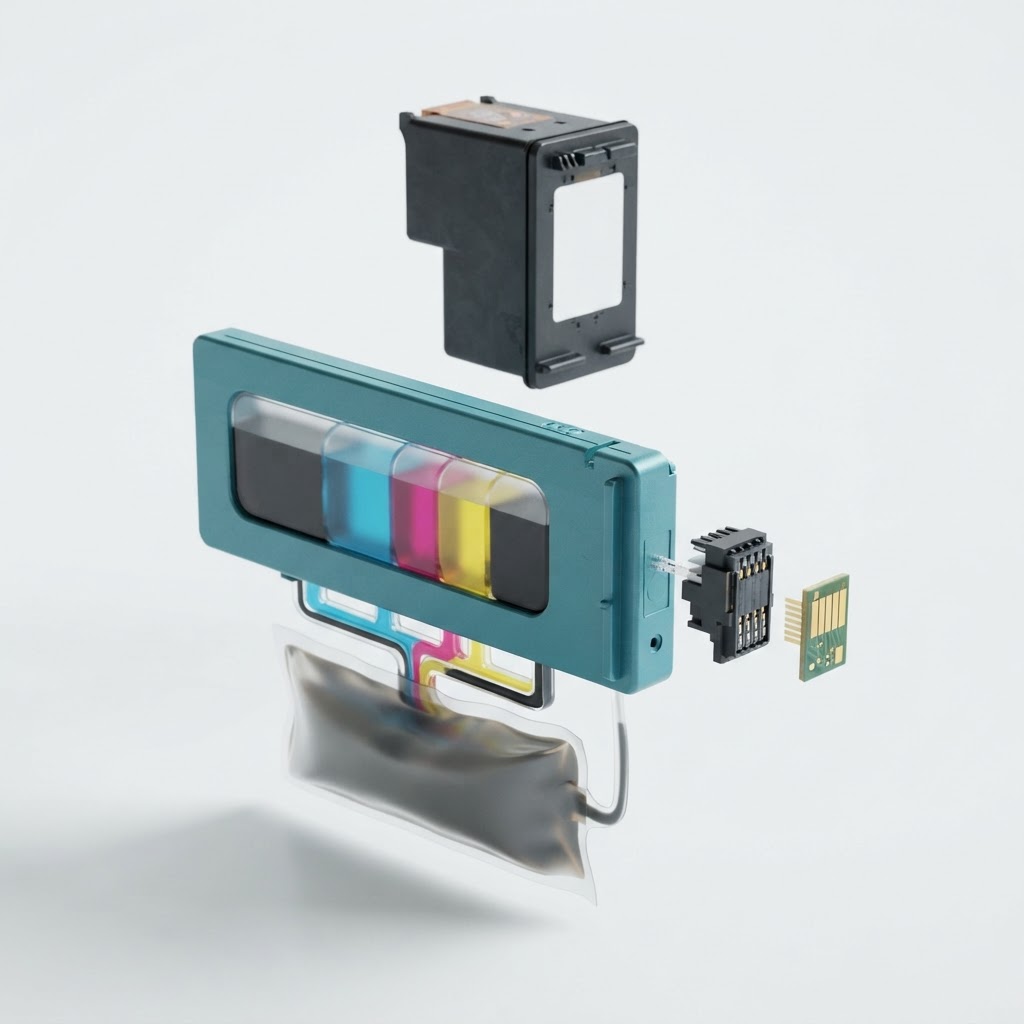
G-CIM slim pouch cartridge
The cartridge — 4.0mm flexible pouch cell
CMY+K pouches, weld-in fitment, dry-break micro-valve
Laptop base cutaway showing printer internals
Inside the laptop base — cutaway
Cartridge dock, fixed head strip, roller drive, all under 18mm

How it works

Student loads a page into the side slot, the device prints, the page comes out. The head never moves.

Paper path through the laptop base
Paper path — straight, single pass
Side-fed cut sheet moves past a stationary head strip
1
Dock
Pouch cartridge snaps into the base deck. Valve opens, fluid path seals to the fixed head.
2
Feed
A cut sheet enters the side slot and is gripped by a rubber roller on a micro stepper.
3
Print
The page passes the stationary 216mm strip once. Four colors lay down in a single pass.
4
Retain
Valve closes on disconnect so the head stays primed. Cartridge swap is ink-free.

The two constraints, and the design answer

A standard TIJ cartridge is too deep for a thin laptop base
The cartridge becomes a 4.0mm flexible pouch cell instead of a rigid box, dropped into a flush dock in the base deck.
A moving carriage needs a rail across the page width
The printhead is a fixed strip. Paper moves past it, single pass, the same architecture as a receipt printer.

Detailed specifications

Cartridge

Form factor
Flexible pouch cell, 4.0mm max thickness, 60 × 140mm footprint
Ink chambers
CMY+K, four isolated pouches, ~3ml each (12ml total)
Ink type
Dye-based aqueous — low clog risk, fast dry on plain paper
Interface
Micro-valve + contact chip, snap-in dock, no ambient air intake
Chip
Authenticity and level telemetry over I2C (G-CIM proprietary)
Shell
Recycled ABS carrier with translucent ink-level window
Lifecycle
~300 worksheets or ~500 flashcards per fill; user refill kit

Pouch interface and dock valve

Pouch laminate
PET/PA/PE multi-layer foil with LDPE inner sealant — the weld surface for the fitment
Fitment (pouch side)
Low-profile weld-in PE flange integrated into the top seam, so the dock port sits flush in the base deck
Dock valve
Dual spring-poppet dry-break quick disconnect — seals before the fluid path opens, reseals on pull
Septum
Silicone septum + O-ring on both coupling halves; liquid-tight before valve open
Tubing
2.5–3mm ID silicone/PU, short run — pouch dock to fixed head is a few centimeters inside the base
Air management
Fitment at the top of the pouch interior, pickup tube dipping to the lowest point; collapsing foil prevents air mixing, no vents
Prime retention
Valve snaps shut on disconnect, holding the stationary head primed against air ingress
Swapping
Ink-free cartridge swap by a student; dock self-purges micro-bubbles into an isolation pocket at the fitment

Printhead

Type
Fixed piezo inkjet strip (open to HP thermal or piezo supply — HP recommendation welcome)
Configuration
Stationary, edge-mounted, no moving carriage
Resolution
600 × 300 dpi (student worksheets, flashcards, certificates)
Print width
216mm strip, portrait Letter/A4 width
Nozzles
~1,150 nozzles across the strip
Paper path
Side-feed, straight, single pass — paper moves past a stationary head
Speed
~1 page / 8–10 sec, acceptable for on-demand student use

Mechanism and envelope

Drive
Micro stepper + rubber roller, receipt-printer class
Media
Cut-sheet, hand-fed single page through a side slot
Power
5V over USB-C, peak ~6W while printing, idle <0.1W
Thermal
Passive cooling; printhead strip mounted to an aluminum heat spreader
Shock
Printhead bonded to the chassis rail; paper roller clutched to slip on impact
Envelope
Every component inside an 18mm base z-height
Envelope summary
18mm max base thickness
4mm cartridge
Stationary head strip
216mm portrait width
~1 page / 8–10 sec
USB-C powered

What we are asking HP to build or confirm

1
Printhead supply or co-development
Confirm which stationary head family HP would put behind this: a cut-down 216mm strip, an arrayed set, or an HP-recommended alternative.
2
Ink formulation
A dye-based aqueous set tuned for a low-duty student printer, matched to the pouch materials so shelf life and clog behavior are characterized.
3
Fitment and valve tooling
The flush weld-in fitment with an integrated dry-break valve is the critical custom part. This is where we need HP's packaging and fluidics expertise.
4
Feasibility verdict on the 18mm envelope
A yes/no from your mechanical and fluidics teams on the fixed-head, moving-paper architecture inside an 18mm base.
5
Volume and program terms
Indicative cartridge MOQ, NRE expectations, and the royalty or supply model HP would want for a custom consumer cartridge.

Questions we would like answered

  • Does a 4.0mm pouch cartridge at 12ml hold enough ink for a 300-page duty cycle at this print density?
  • Is a stationary 216mm strip realistic at 600dpi, or would HP recommend a shorter head with a two-pass scan?
  • Can the dry-break dock hold prime through a year of student connect/disconnect cycles?
  • What does HP require for authenticity chips, and can a partner-branded chip be provisioned?
  • Would HP prefer to own the cartridge tooling and supply finished cartridges rather than license the design?

Next step

A 30 minute technical call with the engineers who would assess the 18mm envelope. If the architecture holds, we will start with a paid feasibility study before any tooling commitment.

Reply to the email this link arrived with to schedule.

Confidential. Specifications are design intent for feasibility discussion, not a manufacturing release. Drawings are concept renderings. G-CIM Inc. 2025.